Urbanista Los Angeles review: Essentially infinite playtime
There’s been a growing trend of eliminating wires in recent years, but since most gadgets house rechargeable batteries, it’s been difficult to completely get rid of them. Wireless charging is picking up pace but it’s not as practical a solution, especially when we consider a category like headphones. What if there was another way around it, though? That’s the epiphany that probably led to the creation of the Los Angeles headphones by Swedish audio company Urbanista. These headphones integrate the company’s “Powefoyle” solar cells in the headband so that they can generate energy from light, be it from the sun or artificial lighting. The claim: virtually infinite playtime.
The result is a pair of cans thatrefuseto die. I mean, seriously. I haven’t managed to get the battery below 80% in over 2 weeks of frequent usage—and I never plugged them in. However, there are a few notable shortcomings that keep me from wholeheartedly recommending the Los Angeles headphones.

Urbanista Los Angeles
The Urbanista Los Angeles headphones offer incredible battery life with their built-in solar panel, but there are a few shortcomings that keep us from wholeheartedly recommending them.
Design, hardware, what’s in the box
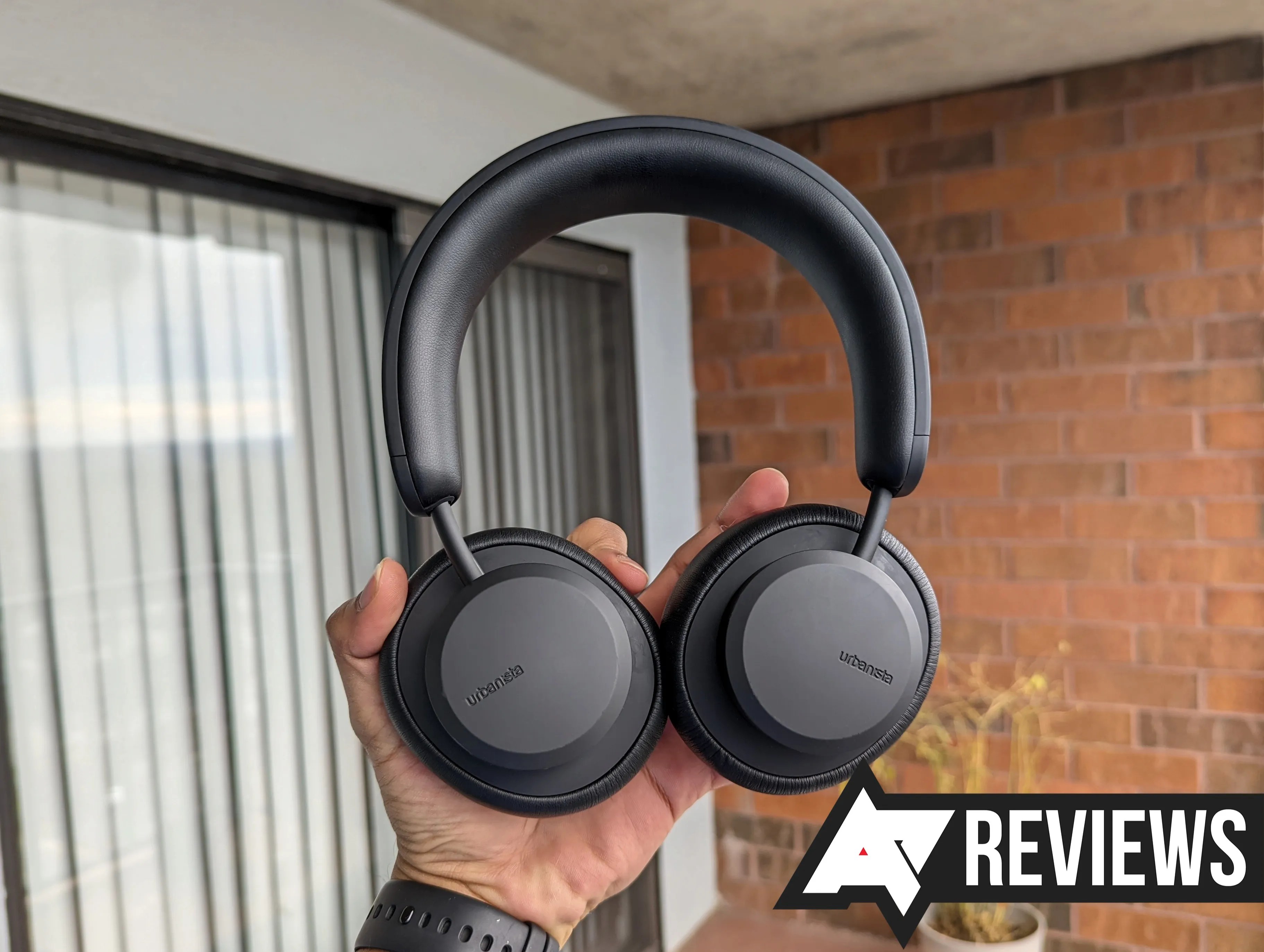
The Los Angeles punch above their weight in terms of design and remind me of the popularAIAIAI headphonesfrequentlyseen on the popular Colors Studio channel. They have a distinctive look with the raised cups, and I’m a big fan of the discreet matte black finish that embraces the similarly-colored solar panel with open arms. It’s going to take more than a casual glance to recognize there’s something odd about the headband. I can’t say the same for the gold colorway, but that might appeal to someone looking for playful contrast.
Everything you touch is made of plastic and Urbanista has left no room to complain regarding its quality. These headphones don’t creak when stretching them to their limits, and the headband adjustment mechanism is smooth and sturdy. If you’re looking to squeeze them in a tiny spot in your backpack though, it might be a disappointment as they don’t fold. They do lay flat, though, and there’s some room to adjust the earcups along the horizontal axis.

I’ve been all praise so far, but there are a few things that do concern me. Firstly, at 320 grams, they’re on the heavier side. The weight on its own is not a deal-breaker—the AirPods Max are even heavier, but Urbanista’s design doesn’t take comfort into account. The deceptive earpads look like they could accommodate an ear and a half, but in fact, there’s very little depth to them, and the openings themselves are smaller than I’d like them to be—my earlobes often scream for air.
A comparison with the Bose QC 45s to give you an idea of the depth of the cups.

As if this weren’t enough, the clamping force of the headphones becomes uncomfortable after a short time. They might loosen over time but the way they are straight out of the box they’re far too stiff for anyone with a large head.
Urbanista chose to go the traditional route for controls, equipping the right earcup with buttons for media playback and the right one for a multi-function button (more on that in the next section). The buttons aren’t well-spaced, and there’s no distinguishing texture to help clue you into which is which. There’s even a USB Type-C port, in case the sun forgets to rise and charge your headphones but don’t spend any time trying to figure out where the headphone jack is cause there is none. I’ve mostly foregone the use of wires so this isn’t tough for me to swallow but this could be a problem for some.

$200 also gets you a USB-C cable and a carrying case, which doesn’t provide much protection since it’s open from the top—a proactive decision to let them charge even when they’re stowed away.
Sound quality, features, and battery
You can pack headphones with all the features you want, but it won’t matter if the audio is bad. Fortunately, the LAs don’t completely fail here—they offer energetic, bass-heavy sound that’s suitable for most genres of music. The bass isn’t overpowering but it sure meddles a bit with vocals and higher-pitched instruments. The clarity won’t compete withthe WH-1000XM4sor theBose QC 45sbut that’s something you probably shouldn’t expect for headphones that cost $199.
Unfortunately, if you’re not a fan of the way they sound, the app doesn’t let you tweak EQ settings; a missed opportunity. Another hitch I noted was the low maximum volume. I’m accustomed to listening to audio at 70-75%, but with the LAs I frequently pushed beyond that to make sure I didn’t miss out on the subtler elements of my tunes. For what it’s worth, the sound doesn’t distort noticeably at higher volumes.
The LAs benefit from ANC, and for the most part, you get what you pay for. No, it’s not going to give Sony’s or Bose’s more premium offerings a run for their money, but they do a decent job of cutting out low-frequency sounds; high-frequency like chatter, not so much. An undesired consequence of turning on ANC is that the headphones sound different; the vocals sound compressed, the bass gets boosted, and the highs aren’t as crisp anymore.
There’s an ambient mode bundled too but it doesn’t do much to keep me away from removing them for a quick chat or an announcement. The wear detection sensor helps as it automatically pauses/resumes music when you remove/wear them.
The raison d’etre of the LAs is to offer “virtually infinite” playtime and boy do they come close. I initially intended on writing this review once I managed to completely exhaust the battery but in the last two weeks, I haven’t even come close. The integrated Powerfoyle solar cells do a darn good job of harvesting energy from free and ubiquitous light. Unless you decide to spend months in a cave that’s completely devoid of light, hanging out with fruit bats and salamanders, you won’t have to charge them with a wire for weeks.
Urbanista claims that an hour in the sunlight should give you about three hours of listening time, and if you live in sunny LA or a similar clime, charging is something you might not have to actively think about. Even in the absence of any light, the headphones are rated to go on for 50 hours with ANC on and a staggering 80 hours with ANC off. Say goodbye to low-battery woes!
Urbanista’s companion app has a very cool and intuitive graphic that shows the energy that’s being consumed and generated at any given time—I’ve spent way too much time just looking at this. The app doesn’t do a lot more, unfortunately, but you’re able to customize what a short and long press of the MFC can do. You can also switch among ANC, ambient, and normal modes with a short press, and summon your phone’s voice assistant with a long one. Like I mentioned previously, it would’ve been nice to see a built-in equalizer too.
Should you buy them?
Maybe. My major concern with the Urbanista Los Angeles is that they aren’t comfortable to wear for more than an hour, and it’s difficult to enjoy music when your ears can’t breathe. This is subjective, so your mileage may vary, but Urbanista’s 90-day refund policy should give you ample time to audition them.
If comfort is not an issue, and you can overlook the lack of EQ and features like Bluetooth multi-point, the Los Angeles are an exciting pair of headphones. They sound alright, offer decent ANC, and make a statement with their design. Who are we fooling though? The real reason to consider these headphones is their stupendous battery life made possible by the solar charging tech. I wouldn’t go as far to say they’ll offer “infinite” playtime—that’s not practical—but they’ll go a long way between wired charges, longer than anything else out there.
I need to give it to Urbanista for integrating this next-gen technology so seamlessly that you don’t even need to think about it consciously; itjust works. I’m looking forward to what’s next from the company and hoping solar panels become a trend. Who wouldn’t appreciate it?
Don’t buy if
UPDATE: 2022/03/03 BY Prasham Parikh
Shine on, you crazy diamond
I still haven’t hooked the Urbanista Los Angeles (LAs) to a charger because the passive solar charging tech has done a phenomenal job at replenishing the battery. In these two months, I’ve not taken them outside a lot, but my desk lamp seems to have provided ample light for the panels to absorb. Is it “infinite playtime” as Urbanista claims? Surprisingly, just about.
Unfortunately, the clamping force hasn’t eased, and the headphones still remain uncomfortable for longer sessions. Since the cups aren’t detachable, there’s no rescue in the form of third-party earpads. To figure if this was just my experience, I made several people try the headphones out and a few of them almost immediately mentioned how tight they felt. Again, your mileage may vary, but the clamping force hasn’t reduced enough overtime to change my opinion.
Only because I have access to more premium picks like the WH-1000XM4s and the Bose QC 45s, I know that the sound quality and ANC are – expectedly – not as good on the $200-priced LAs. So, if you really prioritize those features, previous generations of the Sony and Bose cans are almost as good as the new ones, and they’re available around the same price as the LAs.
There’s no doubt that Urbanista has found a unique, sustainable charging solution that also happens to be extremely convenient. However, its first product to showcase this tech is not as polished as we’d like it to be. I would really like to see the same solar charging tech on more devices.
Carriers get the upper hand
Things get red hot for Magenta
Check your order status!
This article is sponsored by Total Wireless.
Perfect for all types of devices
Breaking language barriers, one feed at a time
