AMD Radeon RX 7900 XTX vs. RX 7900 XT: What Are the Differences?
On December 13, 2022, AMD released the Radeon RX 7900 XTX and the 7900 XT as two top-tier models of its highly anticipated Navi 31 GPU lineup. Based on the company’s latest RDNA 3 microarchitecture, both GPUs share a similar naming convention and feature set while offering stiff competition against Nvidia’s much-maligned GeForce RTX 4080.With that said, how does the Radeon RX 7900 XTX compare to its XT variant in terms of specifications, performance, and overall value? Let’s find out!
RX 7900 XTX vs. RX 7900 XT: Overview
The Radeon RX 7900 Series has been touted as the world’s first gaming GPU built on a chiplet-based design, similar to AMD’s Ryzen, Threadripper, and EPYC CPU lineup. Instead of opting for a conventional monolithic die, Team Red has taken a modular approach with its flagship-grade GPUs to reduce manufacturing costs and facilitate production.
For starters, both the Radeon RX 7900 XTX and the 7900 XT are manufactured using a combination of TSMC’s 5nm and 6nm process nodes to maximize efficiency without sacrificing performance.

The GCD (Graphics Compute Die) has been fabricated on a newer, more expensive N5 chiplet, whereas the surrounding MCDs (Memory Compute Die) utilize an older yet more powerful N6 technology. By interconnecting the GCD and MCDs on an ultra-fast 5.4 TB/s Infinity Fabric link, AMD claims to have achieved a whopping 54% performance-per-watt uplift over the existing RDNA 2 architecture.
RX 7900 XTX vs. RX 7900 XT: Specifications
When it comes to raw compute performance, AMD’s top-of-the-line Radeon RX 7900 XTX includes a fully-featured Navi 31 GCD along with six MCDs, making up for a total of 96 CUs (Compute Units), 6,144 Streaming Processors, 384 TMUs (Texture Mapping Units), and 96MB of Infinity Cache.
Meanwhile, the RX 7900 XT contains the same die layout but with one non-functional MCD, resulting in a maximum of 84 CUs, 5,376 Streaming Processors, 336 TMUs, and 80MB of Infinity Cache.
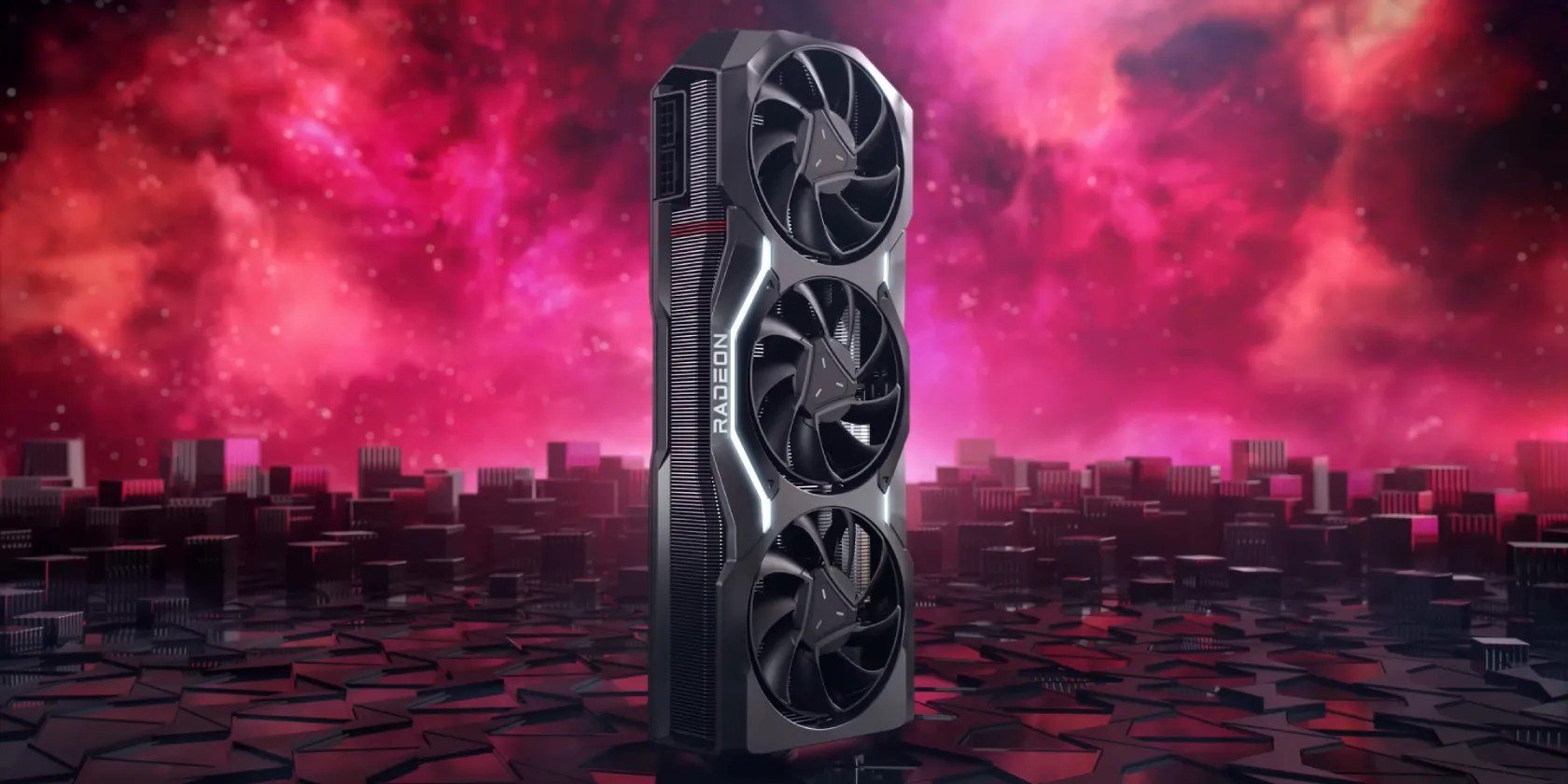
Moving on to the memory subsystem, both GPUs have the same high-speed GDDR6 memory modules rated for a maximum bandwidth of 20Gbps. Since the cut-down XT variant has one of its MCDs disabled by default, it suffers from a 17% reduction in bus width and absolute bandwidth compared to the XTX SKU.
For instance, the RX 7900 XTX, with its 384-bit memory interface, produces an effective bandwidth of up to 3.5 TB/s. In contrast, the 7900 XT’s theoretical bandwidth has been limited to just 2.9 TB/s owing to a narrower 320-bit memory bus. Moreover, the XTX variant ships with a larger 24GB of VRAM, giving it an advantage over the XT’s 20GB frame buffer.

Regarding core frequencies, the RX 7900 XTX runs at a Base Clock of 1,855MHz and boasts a much higher Boost Clock of 2,499MHz. Although the RX 7900 XT gets an advertised Base Clock of 1,500MHz, it manages to gain significant ground with a Boost Clock that hovers around 2,394MHz under full load.
Given the generational improvements in power and thermal management, the RX 7900 XTX comes at a TGP of 355W, whereas the 7900 XT benefits from a slightly lower rating of 315W. However, unlike theRTX 4090’s 16-pin 12VHPWR connectors that are susceptible to melting, both variants feature a couple of tried-and-true 8-pin power adapters on their reference models.

Specifications
RX 7900 XTX

RX 7900 XT
GPU Variant
Navi 31 XTX
Navi 31 XT
Architecture
Process Node (GCD/MCD)
TSMC 5nm/6nm FinFET (N5/N6)
Transistors
58 billion
37 mm² (x6)
Base Clock
Game Clock
Boost Clock
Memory Clock
Memory Speed
Memory Size
Memory Type
Memory Bus
Memory Bandwidth
Stream Processors
Compute Units
Ray Accelerators
Infinity Cache
FP16 (Half Precision) Performance
123 TFLOPS
103 TFLOPS
FP32 (Single Precision) Performance
Minimum PSU Recommendation
Launch Date
12/13/2022
Launch Price
Aside from the differences in compute performance, memory bandwidth, power consumption, and clock speeds, the Radeon RX 7900 XTX and its XT variant take advantage of all the latest and greatest features associated with the RDNA 3 microarchitecture.
By introducing a state-of-the-art Radiance Display Engine that supports dual-link bandwidth over the newDisplayPort 2.1 standard, AMD has opened up the possibility for next-gen display technologies to drive ultra-high refresh rates beyond 1080p — 1440p at 900Hz, 4K at 480Hz, and 8K at 165Hz respectively.
Furthermore, Team Red’s inclusion of an updated Dual Media Engine unlocksAV1 encoding and decodingcapabilities, allowing for superior video compression up to 8K60. In addition to these features, both variants sport a decent collection of video outputs, including two DisplayPort 2.1 connectors, a single HDMI 2.1a socket, and a highly convenient USB-C Virtual Link port.
RX 7900 XTX vs. RX 7900 XT: Gaming Performance
When evaluating the rasterization performance of both GPUs in modern AAA games, it is evident that the Radeon RX 7900 XTX pulls off a comfortable lead over the XT variant by about 15-25%. Not only does AMD’s flagship match or beat the RTX 4080 by a considerable margin, but it also comes ever so close to the RTX 4090—a card that retails for $1,599.
However, when Ray Tracing is enabled on all of these GPUs, the RX 7900 Series, even with its beefed-up Ray Accelerators, struggles to maintain a similar level of performance against Nvidia’s competing Ada Lovelace lineup. At 4K, the RX 7900 XTX is roughly 27% slower than the RTX 4080, whereas the RX 7900 XT widens this gap even further, with a 37% performance deficit across the board.
While dropping the resolution from 4K to 1440p does yield favorable results for Team Read, both variants still require quite a bit of driver optimization to catch up with Nvidia’s enhanced RT implementation. Regardless, the gen-on-gen improvements brought about by the first batch of RDNA 3 GPUs are mighty impressive, especially from a value standpoint.
Which GPU Offers the Best Value for Money?
Coming in at an MSRP of $999, the Radeon RX 7900 XTX represents a better price-to-performance ratio than the cut-down XT variant on most occasions. Although the RX 7900 XT can be obtained for a $100 discount, the performance penalty seems too high to justify its price tag.
Considering the recent surge in GPU pricing, AMD’s current-gen flagship stands out as the best high-end graphics card with excellent rasterization performance and a more balanced power profile than the outgoing RX 6000 Series.
Will AMD take the crown from NVIDIA with these RDNA3 GPUs?
Every squeak is your PC’s way of crying for help.
One casual AI chat exposed how vulnerable I was.
The fix was buried in one tiny toggle.
If an AI can roast you, it can also prep you for emergencies.
You can’t call this offline, Notion.
